You can read every guide on claims, ERAs and denials and still freeze on your first day in a real billing system. Billing is a hands-on job. Employers want people who have already moved a claim from the front desk to a payment, not people who have only read about it.
The problem is that you can’t practice on real patients, and most practice management systems are locked behind a job. This guide shows you how to build real, job-ready billing skills before you are hired, using a practice EHR with a training clearinghouse. It also gives you a 15-step practice routine you can follow this week.
Why reading alone is not enough
Medical billing is a chain. A typo at registration becomes a rejected claim. A missed eligibility check becomes a denial three weeks later. A wrong modifier becomes a reduced payment that someone has to appeal.
You only really understand that chain when you watch it happen. That is why new billers often struggle with the same things:
- Reading an ERA (835) and knowing which amounts are adjustments and which the patient owes.
- Telling a rejection (the claim never reached the payer) from a denial (the payer processed it and said no).
- Knowing what CO-45, PR-1 or CO-97 actually mean for the account.
- Fixing a claim and resubmitting it as an original or as a corrected claim (frequency code 7).
- Billing the secondary payer after the primary pays.
Each of these takes minutes to learn when you can see it on a screen, and weeks to learn from a textbook.
What a good practice EHR should let you do
Not every “practice EHR” is built for billing. Many student systems focus on charting and stop when the visit is documented. If your goal is a billing, coding or front-office job, look for these features:
- A full clinic workflow: scheduling, registration, insurance cards and check-in, not only charts.
- Real code sets in practice: ICD-10-CM diagnoses, CPT and HCPCS procedures, E/M levels and modifiers.
- A clearinghouse: claims should leave the EHR as an 837P batch and come back with acknowledgments (999 and 277CA), just like at work.
- Payer responses that teach: allowed amounts, deductibles, coinsurance, CARC and RARC codes on an ERA.
- Denials and corrections: a way to fix a claim and resend it, and to bill a secondary payer.
- Fictional data only: you should never practice with real patient information.
Fernwell: a practice EHR built for the revenue cycle
We built Fernwell Training EHR because we could not find a practice system that covered the whole revenue cycle at a price a learner can afford. (Fernwell is made by the team behind MedicalBillingInfo.com.)
Fernwell gives you a fictional clinic, Cedar Hollow Medical Group, with providers, a schedule, patients and a realistic payer mix. You can work as front desk, medical assistant, provider or biller and coder. Every patient is fictional and every payer response is simulated, so you can make mistakes safely.
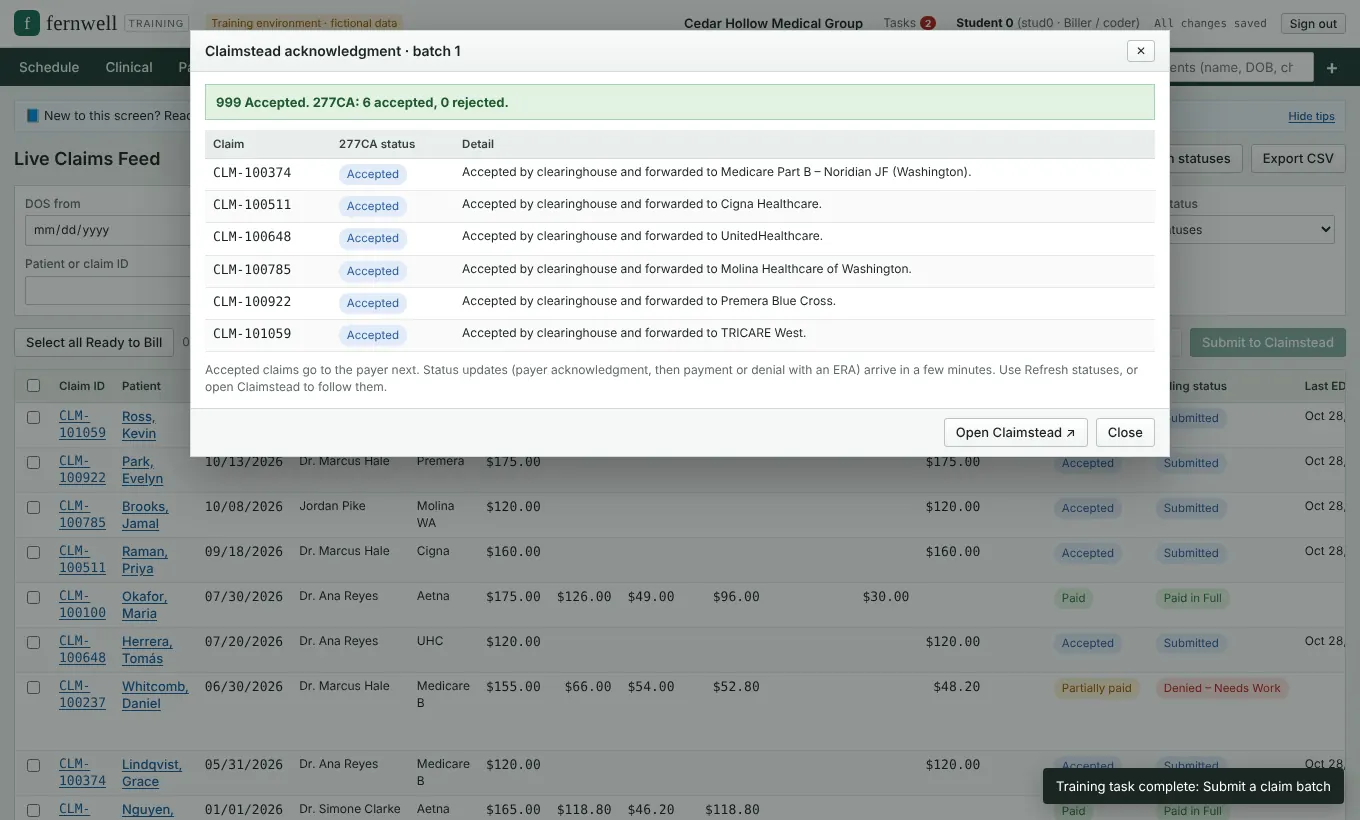
What makes it different is Claimstead, the training clearinghouse that comes with it. When you submit claims, they travel to Claimstead and come back the way they do in a real office:
- Eligibility (270/271): check coverage, copay, deductible and coinsurance. Enter a member ID wrong and you get a real-style error back.
- Claims (837P, 999, 277CA): submit a batch, see which claims were accepted and which were rejected, and why.
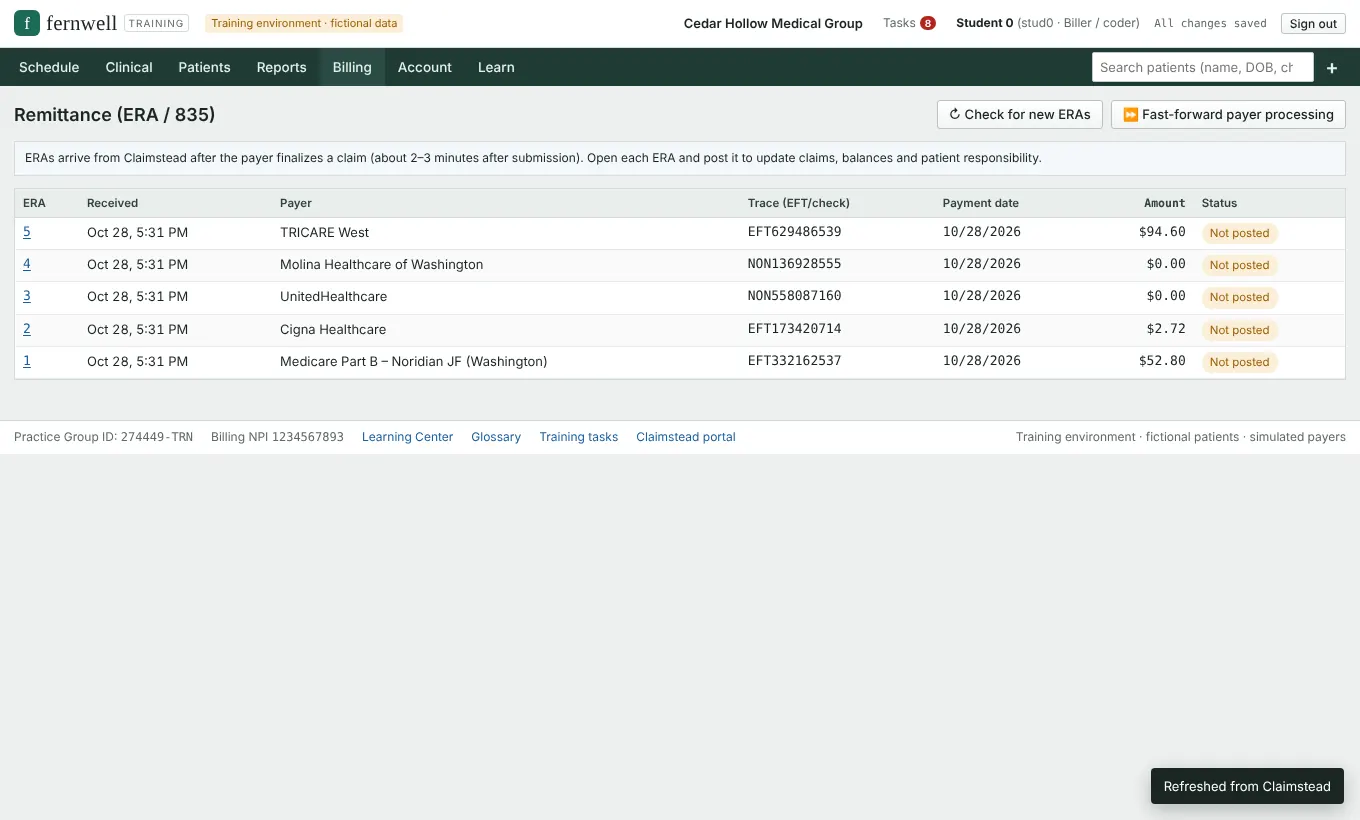
- Payer processing and ERAs (835): see allowed amounts, CO, PR and OA adjustments and CARC/RARC codes, then post the payment in the EHR.
- Claim status (276/277) and prior authorizations (278): follow up on pending claims and request authorizations.
- Fast-forward: skip the waiting so you can finish a full claim cycle in one sitting.
Learn each step, then practice it
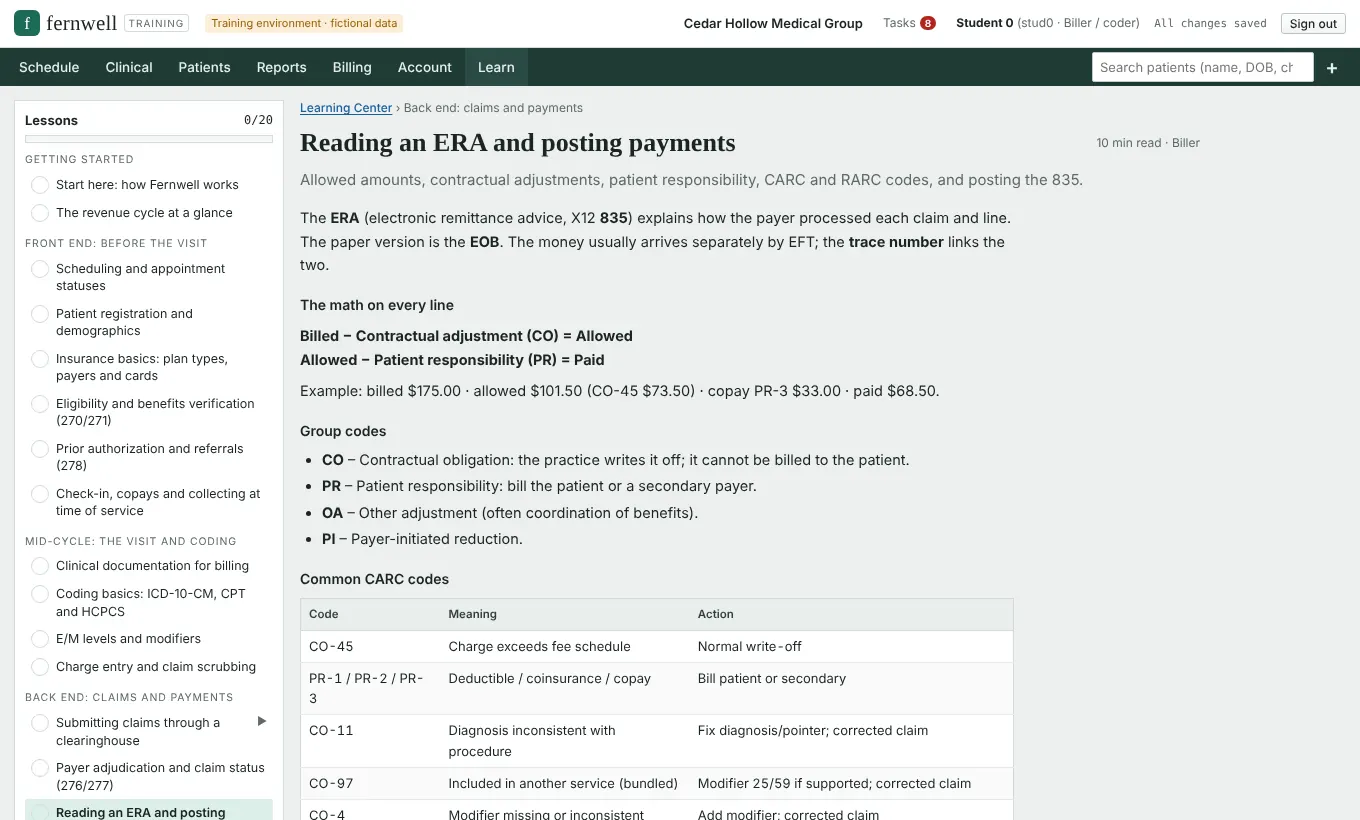
Fernwell includes a Learning Center with 20 short lessons on medical billing and revenue cycle management. Each lesson explains one step and then sends you to the exact screen and practice task for it. A glossary of more than 150 billing terms is linked from every lesson, so an unfamiliar word never stops you.
A 15-step practice routine
Work through one patient visit from start to finish, in this order. Each step builds a skill employers ask about in interviews.
- Schedule the visit with the right appointment type.
- Register the patient and enter the insurance card exactly as printed.
- Verify eligibility and note the copay and remaining deductible.
- Request prior authorization if the service needs it.
- Check in the patient and collect the copay.
- Document the visit (as provider) or review the note (as biller).
- Code the diagnoses and procedures, with any modifiers.
- Scrub the claim and fix anything the checks flag.
- Submit the claim batch to the clearinghouse.
- Read the acknowledgments and correct any rejection.
- Wait for adjudication (or fast-forward it).
- Post the ERA, line by line.
- Work any denial: correct, resubmit or appeal.
- Bill the secondary payer when there is one.
- Bill the patient and follow up on aging A/R.
Repeat it with a different payer each time. Medicare, a commercial plan and a Medicaid plan each behave differently, and that difference is exactly what interviewers probe.
How to turn practice into job offers
- Put it on your resume. “Submitted and posted 40+ practice claims through a training clearinghouse, including corrected claims and secondary billing” is far stronger than “familiar with billing software.”
- Talk through a real example in interviews: a denial you worked, the CARC code, and what you changed.
- Practice the vocabulary. If you can explain the difference between allowed amount, contractual adjustment and patient responsibility, you will stand out.
For instructors and schools
Fernwell also works for whole classes. Each school gets a join code, instructors approve their own students, and a dashboard shows each student’s tasks, lessons and claims. An answer key covers the sample clinic’s cases. Request a school demo.
Start practicing
You do not need a job to get billing experience. You need a safe place to make mistakes and see the results. Try the Fernwell practice EHR and work your first claim from schedule to payment today.